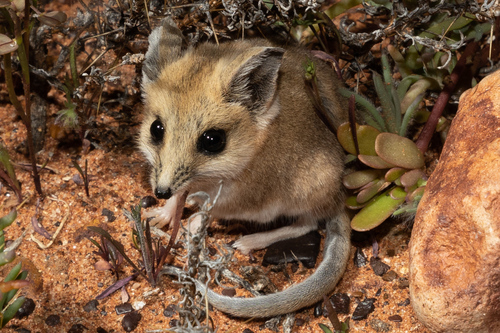
Australia's Hidden Gem: Unveiling the Fat-Tailed Dunnart
Deep within the diverse landscapes of Australia lives a creature that, despite its diminutive size, embodies remarkable resilience and unique adaptations. This is the Fat-Tailed Dunnart (Sminthopsis crassicaudata), a fascinating carnivorous marsupial often mistaken for a common mouse, yet possessing an entirely distinct and captivating life story. Far from being a pest, this tiny native marsupial plays a vital role in its ecosystem, silently navigating the night and thriving on the clever strategy encoded in its very name: its fat-storing tail.
Weighing no more than a few coins and easily fitting into the palm of your hand, the Fat-Tailed Dunnart is a marvel of evolution. Its ability to store vital fat reserves in its tail allows it to endure the harsh realities of the Australian environment, making it a master of survival. Join us as we explore the intricate world of this extraordinary creature, from its physical characteristics to its unique behaviors and the conservation challenges it faces.
Unpacking the Unique Features of the Fat-Tailed Dunnart
To truly appreciate the Fat-Tailed Dunnart, one must first understand its distinctive appearance. This isn't just any small, mouse-like creature; it's a finely tuned predator with specific traits that set it apart:
- Size and Build: Adults typically measure between 60-90mm in head and body length, with a tail that adds another 45-70mm. Despite this length, its weight is astonishingly light, usually between 10-20 grams. This makes it one of Australia's smallest carnivorous marsupials.
- Distinctive Facial Features: The Fat-Tailed Dunnart boasts large, expressive black eyes that are perfectly adapted for its nocturnal lifestyle. Its prominent ears, measuring 14-16mm, are highly sensitive, helping it detect prey in the dark. A pointed snout completes its keen, alert appearance.
- Pelage and Colouration: Its upper body is generally a fawn to brownish-grey, providing excellent camouflage against soil and vegetation. Intriguing darker patches often frame its eyes and head, adding to its distinctive look. Some individuals even display charming white crescent-shaped patches around their ears, making them even more unique. The underside and legs are typically a lighter shade, ranging from light grey to white.
- The Iconic Fat Tail: The most defining feature, and the inspiration for its name, is its tail. When the Fat-Tailed Dunnart is in peak condition and food is plentiful, its tail swells with stored fat, appearing thick and carrot-shaped. This isn't just an aesthetic feature; it's a critical survival mechanism, acting as a portable pantry for leaner times. Conversely, in periods of scarcity, especially during colder months, the tail visibly thins as the animal draws upon these reserves.
It's crucial to reiterate that the Fat-Tailed Dunnart should never be confused with the introduced House Mouse or considered a pest. It is a native Australian marsupial, a member of the Dasyuridae family, which includes other iconic carnivorous marsupials like quolls and Tasmanian devils.
A Wide-Ranging Wanderer: Habitat and Distribution
The Fat-Tailed Dunnart is arguably the most widespread of all dunnart species across Australia, showcasing an impressive adaptability to various environments. Its geographical reach extends across several states and territories, including New South Wales, South Australia, Queensland, Western Australia, and the Northern Territory.
Within this vast range, the species is further divided into two recognized subspecies:
- Sminthopsis crassicaudata centralis: Predominantly found in the more arid, northern regions of Australia, adapted to harsher desert conditions.
- Sminthopsis crassicaudata crassicaudata: Generally found in the southern parts of the continent, including specific concentrations in western Victoria, particularly on the Victorian Volcanic Plains, generally west of the Hume Highway.
Its habitat preferences are as diverse as its distribution. These resilient marsupials occupy a spectrum of open habitats, from expansive open woodlands and low shrublands to parched arid shrublands. Perhaps surprisingly, they have also adapted to live in areas significantly altered by human activity, such as unimproved agricultural pastures. It's not uncommon to find them seeking shelter amongst rock piles, old logs, or even in disused farm structures like old hay sheds. This adaptability highlights their capacity to coexist with certain levels of human disturbance, though pristine habitats remain crucial for their long-term survival.
A particularly favoured microhabitat, especially in regions like the Victorian Volcanic Plains, involves cracking clay soils. These soils naturally form fissures and crevices, providing ideal natural shelters where the dunnarts can escape predators, regulate their body temperature, and establish secure foraging grounds. This diverse range of environments, from natural wilderness to modified agricultural lands, underscores the incredible resilience of the Fat-Tailed Dunnart. Learn more about their diverse homes by exploring From Deserts to Farms: The Fat-Tailed Dunnart's Diverse Homes.
The Survival Secrets of This Nocturnal Hunter
Life as a small marsupial in the Australian wilderness demands highly specialized survival strategies, and the Fat-Tailed Dunnart has them in abundance. Its entire lifestyle is geared towards efficient energy use and resourcefulness:
Nocturnal Foraging and Diet
As a nocturnal creature, the Fat-Tailed Dunnart comes alive under the cover of darkness. Its large eyes and keen sense of hearing are perfectly suited for hunting small invertebrates, which form the bulk of its diet. It is an opportunistic carnivore, preying on a variety of creatures including beetles, spiders, slaters, worms, and slugs. This diet not only provides essential nutrients but also a crucial source of moisture, as the Fat-Tailed Dunnart is remarkably adapted to obtain sufficient water from its prey, often negating the need for free water sources – a significant advantage in arid environments.
The Power of the Fat Tail
The aforementioned fat tail is more than just a descriptor; it's the lynchpin of the dunnart's survival strategy. When food is abundant, typically after rainfall or during warmer months, the dunnart diligently consumes as much as possible, converting excess energy into fat, which is then stored in its tail. This gives the tail its characteristic swollen, carrot-like appearance. When food becomes scarce, such as during droughts or the cooler winter months, the dunnart can draw upon these reserves, allowing it to survive periods of limited prey availability. This ingenious adaptation highlights a core principle of energy conservation in the wild.
Entering Torpor: A State of Energy Conservation
Further enhancing its survival toolkit, the Fat-Tailed Dunnart employs a state known as torpor. During cooler months, when both temperatures drop and food resources dwindle, the dunnart can enter a temporary state of physiological inactivity. During torpor, its metabolic rate, heart rate, and body temperature significantly decrease, drastically reducing its energy expenditure. This allows the dunnart to conserve precious energy and effectively "hibernate" for short periods, waiting out unfavorable conditions until food becomes more accessible. This incredible ability to manage its energy budget is a testament to its evolutionary success. For more in-depth information on their survival tactics, read Fat-Tailed Dunnart: How This Carnivorous Marsupial Survives.
Reproduction and Conservation: Ensuring the Future of the Fat-Tailed Dunnart
The life cycle and conservation status of the Fat-Tailed Dunnart offer valuable insights into its ecological role and the challenges it faces.
A Rapid Reproductive Cycle
The Fat-Tailed Dunnart exhibits a polyestrous breeding pattern, meaning females can have multiple breeding cycles within a season, typically from July to February. Gestation is remarkably short, lasting only 13-16 days. Litters can be quite substantial, with females giving birth to up to 10 tiny, underdeveloped young. These young immediately make their way to the mother's pouch, where they attach to a teat and continue their development for approximately 65-69 days before dispersing. Sexual maturity is reached relatively quickly, around 155 days for females and 159 days for males. Given its average lifespan of about 15-18 months, this rapid reproductive cycle is essential for maintaining stable populations.
Conservation Status and Threats
Globally, the Fat-Tailed Dunnart is assessed as "Least Concern" by the IUCN (International Union for Conservation of Nature). This designation reflects its wide distribution across Australia and generally stable populations. However, this global status can be misleading, as regional populations often face significant vulnerabilities.
In certain areas, particularly in Victoria where its populations are more concentrated, the Fat-Tailed Dunnart faces several pressing threats:
- Habitat Fragmentation: The clearing of land for agriculture and urban development leads to fragmented habitats, isolating dunnart populations and making them more susceptible to local extinction.
- Competition with Introduced Species: Introduced herbivores can degrade the habitats these dunnarts rely on, reducing food availability and suitable shelter.
- Predation by Feral Animals: Feral cats and foxes pose a significant threat. Being small and nocturnal, dunnarts are particularly vulnerable to these highly efficient introduced predators.
Understanding these regional challenges is crucial. While not endangered on a global scale, localized conservation efforts, such as protecting and restoring native vegetation, controlling feral predators, and promoting sustainable land management practices, are vital to ensure the continued survival of this extraordinary marsupial in all its native habitats.
Conclusion
The Fat-Tailed Dunnart stands as a testament to the incredible diversity and resilience of Australia's native wildlife. From its unassuming size and distinctive fat-storing tail to its widespread distribution and sophisticated survival strategies, every aspect of its life story is fascinating. As a nocturnal hunter, a master of energy conservation, and an adaptable inhabitant of various ecosystems, it plays a quiet yet crucial role in maintaining the balance of its environment.
By shedding light on the unique characteristics and challenges faced by the Fat-Tailed Dunnart, we hope to foster greater appreciation and understanding for this tiny, yet mighty, marsupial. Its continued presence in Australia's wild places is a barometer of environmental health, reminding us of our shared responsibility to protect and preserve the intricate tapestry of life that makes our planet so remarkable.